The Death of Robin Hood
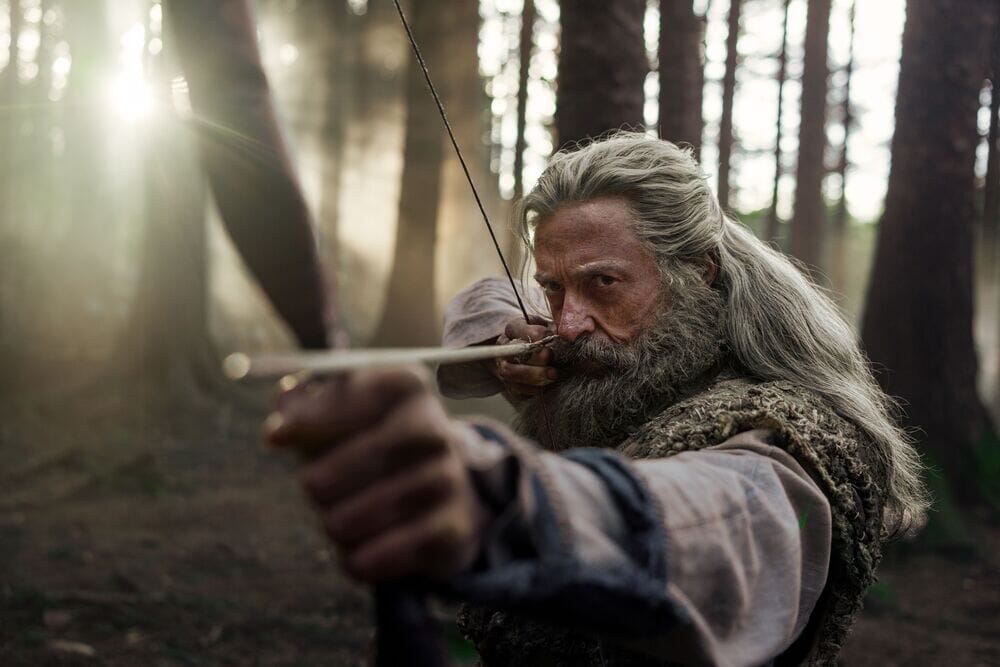
Hugh Jackman stars in THE DEATH OF ROBIN HOOD. (Photo: A24)
Could generation upon generation have been wrong? For the eponymous outlaw in The Death of Robin Hood, his feathered cap, his merry men, and certainly his penchant for philanthropy are nowhere to be found.
Rather, this bleak and brutal period drama reimagines Robin Hood as a brooding 13th century outsider reflecting on his own mortality while contemplating a legacy of relentless savagery and cold-blooded murder.
However, as a tale of moral reckoning, this haunting character study is too often unpleasant rather than insightful. Perhaps credit is due for the subversive concept, although the result is more tedious than provocative.
As the film opens, Robin (Hugh Jackman) is huddled near a campfire in the rugged highlands. “He was not a hero,” Robin explains self-referentially to an oblivious stranger. “He robbed and killed for the joy of it, nothing more.”
Robin’s subsequent actions validate that claim, as the archer launches arrows through eyeballs and axes bystanders in a rage-filled vendetta alongside his partner, Little John (Bill Skarsgard).
After being severely wounded, he’s rescued by a nun (Jodie Comer) at an island priory who nurses him back to health. Concealing his identity during his recuperation, Robin’s perspective changes following encounters with a leper (Murray Bartlett) and a wounded orphan (Noah Jupe).
He’s forced to confront the demons and past tragedies that motivate his violent and remorseless misdeeds. Along the way, the titular outcome feels inevitable.
Beneath his weatherbeaten face and bushy gray beard, Jackman generates hard-earned sympathy for a tormented man given a last chance at redemption.
The film stylishly captures the harshness of its remote setting — blanketed in fog and teeming with despair — where survival instincts are vital.
The deliberately paced screenplay by director Michael Sarnoski (Pig) deconstructs the Robin Hood ethos while broadly examining the nature of folk heroism, and how tall tales and mythical figures are often enhanced by blind faith and naïve optimism.
But the film struggles to get inside the head of its brooding protagonist before the second half becomes more contrived and conventional as it charts a path to catharsis.
You don’t need an 800-year-old folktale to distinguish the value of false hope over harsh reality. The Death of Robin Hood illustrates that belief in unintentional ways.
Rated R, 123 minutes.