Desert Warrior
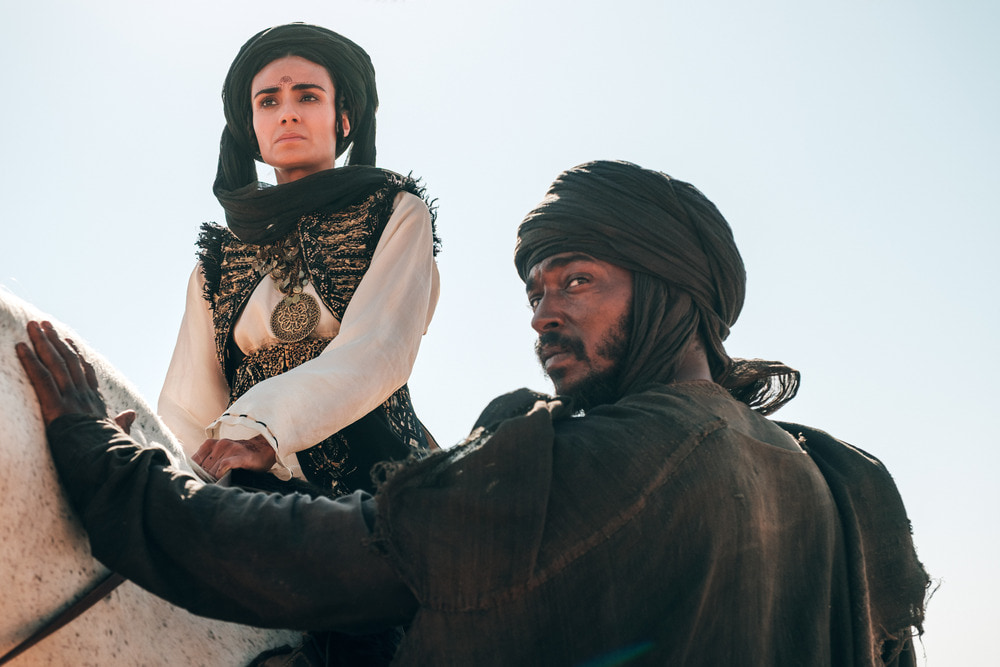
Aiysha Hart and Anthony Mackie star in DESERT WARRIOR. (Photo: Vertical)
Emphasizing spectacle over substance, Desert Warrior is an intermittently thrilling throwback sword-and-sandals epic in which the historical setting rarely feels convincing.
This period adventure from director Rupert Wyatt (Rise of the Planet of the Apes) vividly captures foreboding desert landscapes that feel dystopian in their territorial savagery and cutthroat survival tactics.
Unfortunately, the film lacks character depth or thematic texture in exploring an oppressive culture of misogyny and authoritarianism through a contemporary feminist lens.
It’s set in seventh century Arabia among exiled outlaws, grifters, and mercenaries with weather-beaten faces, traversing the arid climate on camelback or horseback while potential danger lurks behind every sand dune or rocky cliff.
The backdrop is a pre-Islamic region embroiled in sociopolitical turmoil and tribal warfare under the regime of Emperor Kisra (Ben Kingsley), ruthless leader of the Persian Empire who sees women as concubines.
Away from the affluence, allegiances are fragile, which is why an unnamed bandit (Anthony Mackie) is skeptical when he keeps encountering a fugitive princess, Hind (Aiysha Hart). “Things always get worse when you show up,” he exclaims.
Having fled the city, Hind’s goal becomes uniting the outlaws and leading a rebellion while Kisra’s military officer (Sharlto Copley) remains in pursuit.
She forms a reluctant partnership with the Bandit in which their only loyalty is to one another as their respective physical resolve and moral boundaries are tested. She’s resilient and empowered, and refuses to be constrained or controlled.
As the film gradually shifts perspective — it’s not apparently until halfway through to whom the title refers — one issue is that the enigmatic bandit is a more charismatic and captivating antihero than Hind.
Apparently inspired by real events, the revisionist screenplay — credited to Wyatt and his wife, Erica Beeney, along with David Self (Road to Perdition) — strings together some stylish confrontations and set pieces while struggling to escalate the underlying emotional stakes or amplify the historical context.
One highlight is a stirring climactic battle sequence with control of the kingdom in the balance, which provides a surge of adrenaline the majority of the film lacks.
Infused with western influences, Desert Warrior is impressive more for its scope than its storytelling, which becomes stranded without an oasis in sight.
Rated R, 126 minutes.