Blue Moon
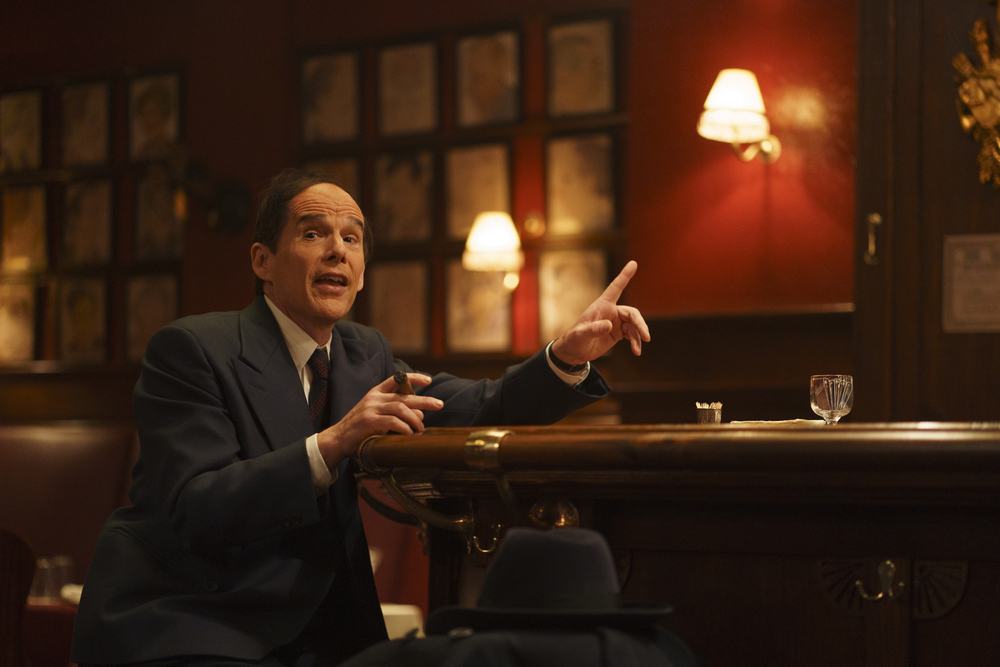
Ethan Hawke stars in BLUE MOON. (Photo: Sony Classics)
The smooth melody of its namesake ballad belies the sharp edges of its co-creator in Blue Moon, a fictionalized peek into the birth of Broadway’s golden age driven by a magnetic performance by Ethan Hawke.
The latest of several collaborations between Hawke and director Richard Linklater (Boyhood) is not a comprehensive biopic, nor is the actor’s portrayal rooted in mere mimicry. Together they create a richly textured period piece depicting a man of fascinating contradictions.
It essentially chronicles one night, a few months before his death, for Lorenz Hart (played by Hawke), famed lyricist for such classics as “The Lady Is a Tramp” and “My Funny Valentine” alongside composer Richard Rodgers.
He’s charming and gregarious, but also lonely and insecure as he wanders into a Manhattan nightclub in March 1943 following the rapturous premiere of Oklahoma!, penned by Rodgers and Oscar Hammerstein.
Regaling a patient bartender (Bobby Cannavale), he claims to be waiting for the arrival of Rodgers (Andrew Scott) and a starlet (Margaret Qualley) who Hart finds alluring despite his sexuality suggesting otherwise. He claims to have hated the play, perhaps out of petty jealousy.
Hart is eager to share his self-deprecating anecdotes and philosophical rants — covering sexuality to art to current events — to anyone within earshot, even if it seems like half of his stories are fabrications or at least exaggerations. “I went directly from childhood to washed up,” he jokes.
He adores Rodgers, and himself, while offering acerbic takedowns of just about everyone else as the evening progresses. As more guests appear, he mingles with hopes of restarting his spiraling career, yet with an unwillingness to compromise.
You can see why one person would find Hart witty and enchanting and the next would claim he’s obnoxious and insufferable. But he’s never boring — and neither is the movie, despite its logistical limitations.
Hawke’s physical transformation includes a hunched posture and an almost cartoonish combover. He’s fully immersed in a role in which he’s rarely silent or off camera.
Outside of his performance, it’s more modest and forgettable, using Hart to explore a bygone Broadway era in a project draped in bittersweet nostalgia.
For better or worse, Blue Moon turns an abbreviated chapter in his life into a filmed stage play that Hart might have loved. The rest of us are more apt to admire rather than fully enjoy it.
Rated R, 100 minutes.