The Wizard of the Kremlin
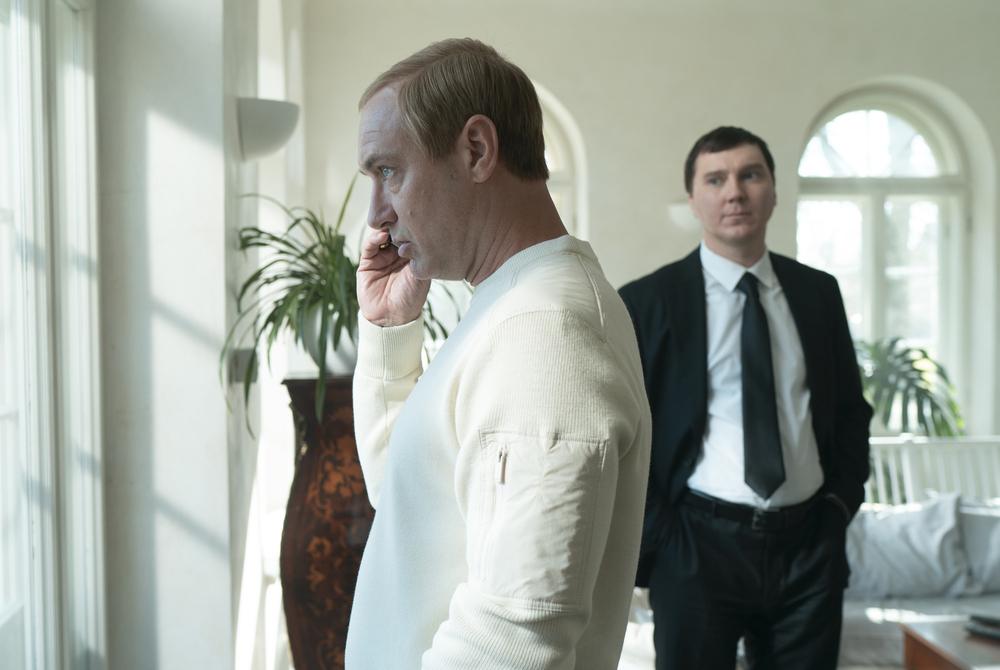
Jude Law and Paul Dano star in THE WIZARD OF THE KREMLIN. (Photo: Vertical)
As it peels back the curtain on the political landscape in post-Soviet Russia, The Wizard of the Kremlin reveals some parallels that will be unsettling — if hardly surprising — to American audiences, and not just because the film plays like a variation on The Apprentice.
This ambitious thriller from French director Olivier Assayas (Wasp Network) is a wildly uneven yet consistently fascinating glimpse into Vladimir Putin’s rise to power seen through the eyes of a fictional acolyte who becomes corrupted by power.
The sprawling material seems better positioned as a miniseries, where it could get inside the heads of its characters without having to cover so much chronological ground. As it stands, despite a solid cast, this adaptation of a Giuliano de Empoli novel struggles to translate its dense material from page to screen in a more incisive or provocative way.
The story is told primarily through a framing device involving an American writer (Jeffrey Wright) visiting Russian diplomat Vadim Baronov (Paul Dano), who had been Putin’s chief advisor.
Through flashbacks, we learn how Baronov began as an idealistic theater producer before transitioning into television during the tumultuous Boris Yeltsin administration. From there, he’s hired essentially as a media strategist to turn a former KGB officer into a viable candidate for national office.
Baronov’s love affair with an artist (Alicia Vikander) is his only respite from the shifting power dynamics during events ranging from the Chechen wars to the Sochi Olympics, each of which Putin (Jude Law) and Baronov use to tighten their political stranglehold.
Meanwhile, Baronov becomes a morally compromised opportunist seeking to justify his enablement of the authoritarian regime. Through shady tactics, he becomes a master manipulator who creates a monster. His primary mistake, of course, is assuming that his loyalty was reciprocated.
Despite some monotonous narration, Dano’s understated performance fleshes out Baronov’s transformation from a charismatic free-thinker into a button-pushing propagandist consumed by conspiracies, paranoia, and Putin’s twisted worldview.
Eventually the film validates its primary focus on Baronov over Putin, for whom Law eerily captures the callous demeanor and cartoonish alpha mannerisms. It’s amusing to imagine how the Russian president probably would be most upset with the fact that he plays second fiddle.
Straddling a line between insightful and inflammatory, the film’s chilling resonance feels muted. The Wizard of the Kremlin is intriguing, but keeps moviegoers too safely protected from its horrors.
Rated R, 136 minutes.