Capsule reviews for Jan. 9
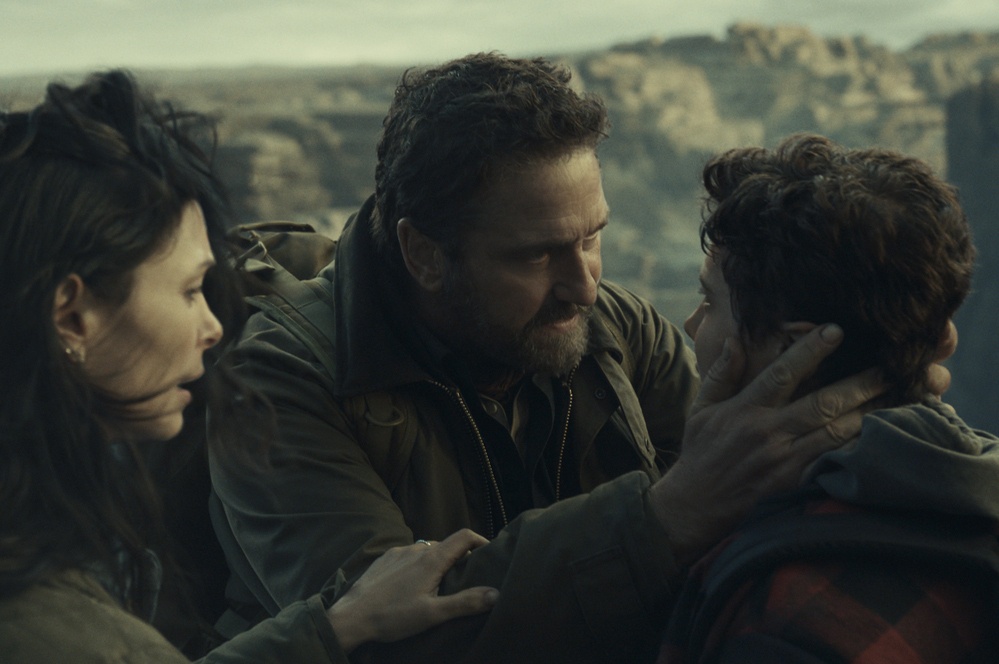
Morena Baccarin, Gerard Butler, and Roman Griffin Davis star in GREENLAND 2: MIGRATION. (Photo: Lionsgate)
The Chronology of Water
A ferocious portrayal by Imogen Poots (All of You) propels this uneven directorial debut from actress Kristen Stewart, a powerful glimpse into the lingering effects of childhood trauma. Poots plays Lidia, still reeling as an adult from an abusive upbringing when her athletic aspirations are shattered by addictions and self-harm, eventually prompting her to find an outlet through writing. Often shot in closeup, Poots inhabits the role by channeling Lidia’s resilience, while Stewart’s nonlinear screenplay — based on Lidia Yuknavich’s memoir — confronts the struggles faced by victims and acknowledges the difficulties of finding catharsis. Despite some stylistic gimmicks and thematic familiarity, it’s admirably raw and heartfelt. (Rated R, 128 minutes).
Greenland 2: Migration
Just as its characters wander aimlessly in search of a path forward, so does this sequel to the 2020 disaster thriller from returning director Ric Roman Waugh, which awkwardly infuses grounded humanity into a progressively ridiculous series of mini-calamities. Having escaped to the titular island after a rogue comet decimated Earth, resourceful John Garrity (Gerard Butler) must relocate a group of survivors including his wife (Morena Baccarin) and teenage son (Roman Griffin Davis) from new threats both environmental and man-made. The dystopian set pieces are sharply crafted and appropriately tense, although the scenarios feel contrived and formulaic, caught between genre expectations and exploring new territory. (Rated PG-13, 98 minutes).
My Neighbor Adolf
While its two esteemed actors generate an amusing adversarial chemistry, the one-joke premise feels strained in this idiosyncratic comedy about grumpy old men. It’s set in South America in 1960, when Holocaust survivor Polsky (David Heyman) would rather be left alone to tend to his roses. So he grows irritated when the demanding Herzog (Udo Kier) moves in next door, becoming convinced that Herzog is actually an exiled Hitler. Building his case forces him to build an uneasy bond with the newcomer while keeping his intentions secret. The highly uneven film awkwardly tries to layer its broad caper comedy with sentiment, without sufficient emotional depth. (Not rated, 91 minutes).
Obex
Taking us back to the glory days of floppy disks and dot-matrix printers, this delightfully quirky microbudget comedy is also an unsettling probe of insecurity and paranoia. It’s set in 1987, almost entirely inside the apartment of Conor (director Albert Birney), who works from home using his programming skills on primitive home computers. Haunted by a troubled past, his obsession with the titular new game upends his solitary routine, leaving Conor torn between reality and a surreal, pixilated fantasy realm. Despite uneven narrative momentum, the film’s defiantly lo-fi visuals — rendered in black-and-white — evoke heartfelt nostalgia and enhance a thinly plotted script that eventually finds its way. (Not rated, 91 minutes).
Sleepwalker
Staying awake could be an issue while enduring this tawdry and incoherent psychological thriller that’s likely to produce more giggles than frights. It follows a grieving mother (Hayden Panettiere) whose daughter was killed in a snowy car accident that left her abusive husband (Justin Chatwin) in a coma. Trying to move forward while caring for her traumatized son (Laird LaCoste), she’s afflicted by nightmares that leave her unable to distinguish dreams from real life. Accented by constant music swells, the screenplay by rookie director Brandon Auman toggles reality and fantasy with little regard for logic or coherence, straining to preserve a ridiculous climactic twist. (Not rated, 89 minutes).
Young Mothers
With their usual clear-eyed compassion for working-class struggles, the latest low-budget drama from Belgian filmmakers Luc and Jean-Pierre Dardenne (Rosetta) offers a multilayered portrait of motherhood in a world of fractured families and socioeconomic constraints. Its loosely connected stories involve women in a Liege residential shelter who are pregnant or recently gave birth — with the fathers only marginally in the picture — capturing their anxieties and mental fatigue, along with the day-to-day realities of being a provider and caretaker with limited resources. The disjointed structure limits the contextual depth in each subplot, yet the expressive performances from acting newcomers provide hard-earned sympathy and help build a cumulative potency. (Not rated, 106 minutes).