Nuremberg
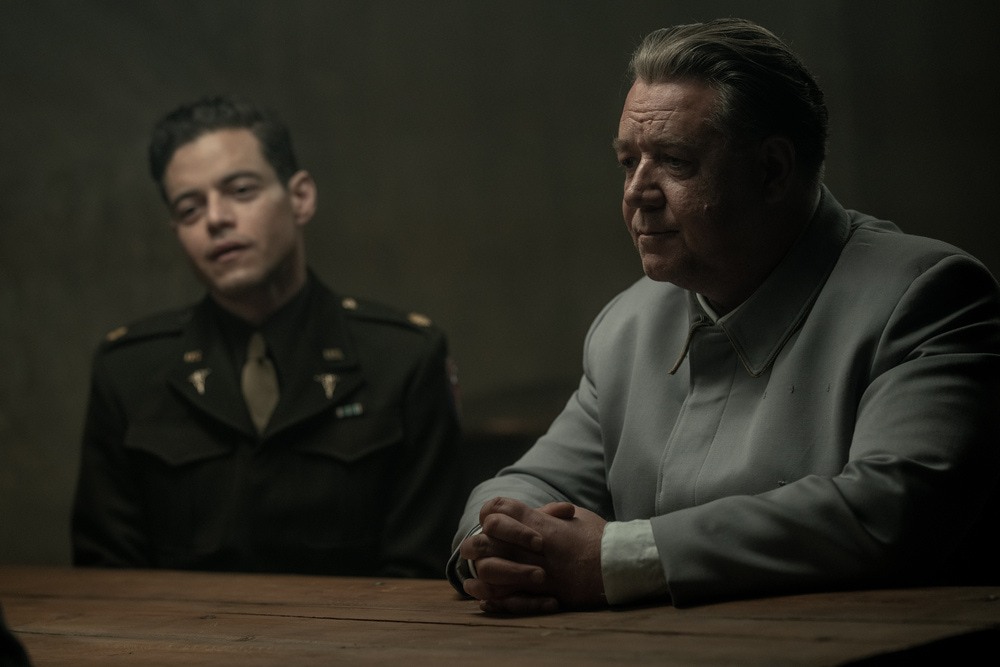
Rami Malek and Russell Crowe star in NUREMBERG. (Photo: Sony Pictures Classics)
Even if you know the outcome, Nuremberg shows that one of the 20th century’s most prominent examples of crime and punishment is still chilling, 80 years later.
After some awkward exposition, this well-acted drama becomes taut and tightly focused in the second half, with its solid historical insight bolstered by a first-rate cast and stylish period re-creation.
Building tension as the stakes intensify, the film overcomes some melodramatic tendencies while making its true-life story both enlightening and engaging.
It’s set during the chaotic aftermath of World War II, when the highest ranking survivor of the Nazi regime is Hermann Goring (Russell Crowe), who is apprehended by American authorities and accused of war crimes.
His complicity seems obvious, yet since there’s no precedent — and no attack took place on U.S. soil — building a case for a multifaceted tribunal is complicated for lead prosecutor Robert Jackson (Michael Shannon) and requires cooperation from allies in France, the United Kingdom, and the Soviet Union. “This war ends in a courtroom,” Jackson explains. “As he falls, so do they all.”
Much of the story focuses on the cat-and-mouse between Goring and Army psychiatrist Douglas Kelley (Rami Malek), brought on board by Jackson’s team to ensure Goring and 21 other Nazi officers are mentally fit for trial.
Goring seems deceptively cooperative in captivity, but it’s clear he’s playing mind games. His intimidation tactics make him frightening as he remains defiant in his allegiance to a lost cause — convinced he can charm Kelley and manipulate the system into letting him walk free.
The film smartly varies its perspective while covering the same subject matter as the Oscar-winning 1961 epic Judgment at Nuremberg, although comparisons will be hard to shake.
The screenplay by director James Vanderbilt (Truth), adapted from a nonfiction book by Jack El-Hai, feels somewhat didactic in its setup, whether detailing the sociopolitical order in Europe after the fall of Hitler, or describing the intricacies of international law.
With its straightforward native approach, the film is well researched as a legal thriller, even if it’s speculative and streamlined for mainstream consumption.
Still, the thematic depth and moral complexity are elevated in part by some riveting exchanges, both inside and outside the courtroom, that fuel its emotional potency.
Inviting you to draw contemporary parallels as you wish without turning heavy-handed, Nuremberg resonates in ways its subjects never could have anticipated.
Rated PG-13, 148 minutes.