Good Boy
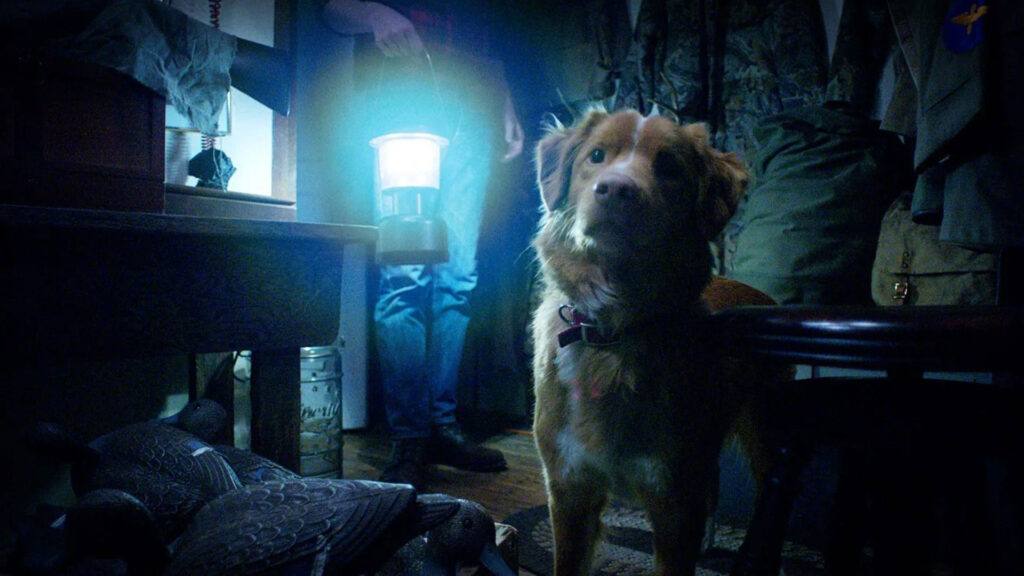
Indy as himself in Ben Leonberg's GOOD BOY.
How do you tell a dog that a loved one died?
My wife and I faced that question in 2021 when our thirteen year-old red heeler was diagnosed with splenic cancer. On a visit to the vet we thought her bloated appearance was due to worms. The vet, who had known our dogs almost their whole lives, emerged from the exam room, sullen, with a syringe full of blood she’d just extracted from Clementine’s abdomen. Within a couple of weeks our beloved canine declined rapidly. We made the difficult decision to spare her of further pain and nightly struggles to breathe. But the hardest part was yet to come…
Arriving back home, we had no explanation for Clementine’s absence to offer her younger sibling, Ophelia, that she could possibly understand. As the days passed, we underestimated Ofie’s anger and frustration with us. How do you tell a dog that their closest companion with whom they’d played, fought, argued, and bamboozled, their entire life, wasn’t ever coming home? If you can’t make sense of it for her, how does she? We can only wonder, at some point, how our dogs process grief, how they cope, how they move on.
The life of a dog is complex. Indy, doesn’t understand much of the human world except for Todd (Shane Jensen), his whole world and owner since he was a pup. Other people, including Todd’s sister Vera (Arielle Friedman)—constantly checking in on her ailing brother—come into and out of the picture, never perceived by Indy as clearly as Todd’s voice.
We learn from home videos that Todd’s grandfather (Larry Fessenden) mysteriously passed, leaves his taxidermy collection to Vera and his house to Todd. Having just made it out of a stint in the emergency room, Todd appears to develop the same illness to which Gramps succumbed. Confused by Todd’s personality changes and the new surroundings, punctuated with creaks and moans he doesn’t understand, Indy does his best to try to make sense of the situation.
Early in the film, Todd gives us a vague clue as he heads down the stairs to the basement, “Something smells awful down here. Glad I don’t have your nose!”
From here, the mystery deepens not just with the noises coming from parts of the house, especially the basement, but also with the constant downpour of rain, some of it leaking into the garage where Todd’s grandfather kept his recliner and lamp.
Indy’s quizzical expressions, abrupt over-the-shoulder glances and moments of sheer terror in his eyes, combined with shrewd editing and low camera angles, transport us into a dog’s state of mind better than any number of banal CG manifestations with voice-overs in the film’s spartan seventy-three minute running time. It’s possible they could’ve extended the backstory with the sister, and in doing so, built some relationship between Indy and her—also adding to Indy’s confusion toward his owner’s circumstances.
Anyone who’s ever tried to encourage a dog to do something in-camera understands the difficulty writer/director Ben Leonberg, Indy’s real owner, faced. Because the filmmakers clearly tried to capture Indy being Indy, motivating his curiosity with natural cues rather than struggling to get him to the level of a trained acting dog, the film runs shorter than the standard 90 minute minimum. But it works well, as we develop real empathy for Indy. Just as clever is the sound editing. Even the voice on the car radio blares unintelligibly, exactly as Indy would perceive it. In the same way Spielberg knew to film E.T. at the eye level of a child, Leonberg here works with Indy’s height and other limitations to confine us to how he sees and connects with the world, with others.
It’s said that a dog’s sense of smell is as many as 150,000 times stronger than our own. Suffice it to say when Indy picks up a scent, it transports us to another moment in time, perhaps another’s memories, another’s story. Indy, we learn, is not the only good boy of the house. The movie avoids the tedium of certain supernatural tropes by cleverly establishing that Indy’s lens into the past is a combination of his superlative olfactory ability as a dog combined with a rich inner life and imagination, manifesting in equal parts good and evil.
Similarly, Ophelia would frequently get lost in her own thoughts or we’d catch a glimpse of her looking up at the night sky—ever curious, ever reaching for things you’d think a dog couldn’t grasp. Eventually Ophelia’s days came to an end, sixteen long and wonderful years after we by chance came into her world. I tell myself that in that moment, in that room, with that vet, the end of Clementine’s journey came into focus for her as well.