28 Years Later
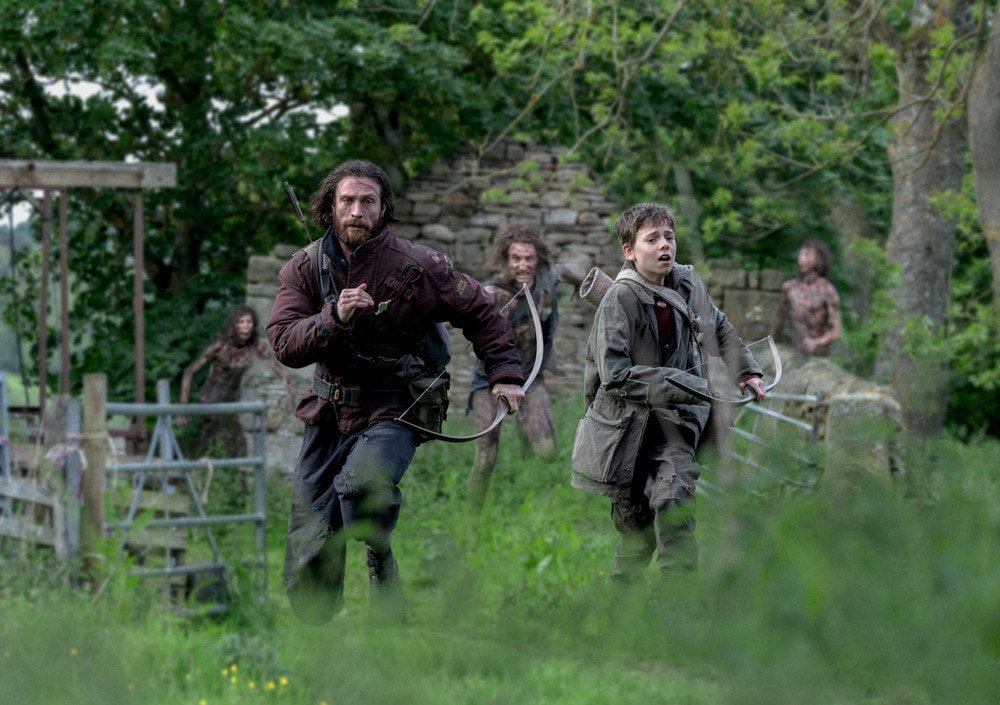
Aaron Taylor-Johnson and Alfie Williams star in 28 YEARS LATER. (Photo: Columbia Pictures)
Situated within a franchise that probably didn’t need to be resurrected, 28 Years Later is bitten by its connections to the past and the future.
At times an audacious and thoughtful dystopian survival thriller with hints of greater thematic aspirations, the latest follow-up to the 2002 horror saga 28 Days Later is visually stylish yet narratively uneven and heavy-handed.
Worse yet, its bookend sequences transparently provide a link to another forthcoming sequel rather than assuring a proper ending for its characters or for moviegoers, who might as well wait on this bloody feature-length prologue and catch up later.
The plot has little connection to the prior chapters, other than it’s set 28 years after the “rage virus” that caused the United Kingdom to become ravaged by highly contagious and aggressive zombies.
A group of survivors have taken shelter on a remote island off the Scottish coast, adopting a primitive lifestyle of hunting and gathering. That’s where we meet Spike (Alfie Williams), a precocious 12-year-old who lives with his father, Jamie (Aaron Taylor-Johnson), and mother, Isla (Jodie Comer) — who is bedridden with a mysterious illness.
As a rite of passage, Jamie takes Spike to the mainland to test his archery skills against easy targets among the “infected.” Such a mission also ensures they must face more dangerous predators.
With his curiosity piqued and his relationship with Jamie later strained, Spike takes it upon himself to venture into hostile territory again, desperately searching for a reclusive doctor (Ralph Fiennes) who might have Isla’s cure.
The film benefits from the return to the franchise of original director Danny Boyle (Slumdog Millionaire) and screenwriter Alex Garland (Civil War), who bring technical craftsmanship and layered storytelling to an overcrowded genre.
The zombie confrontations carry a visceral intensity along with a video-game mentality and plenty of gratuitous gore (via slow-motion kills). Boyle ratchets up the urgency with angled cameras and extended chase scenes.
However, the extended stretches in between aren’t as involving, due to thinly sketched characters and a somewhat contrived story. Its allegorical metaphors and satirical swipes don’t translate to sufficient emotional depth.
Considering the talent behind the scenes, you’re left with the feeling that 28 Years Later has bigger ideas on its mind than what it shows us. Perhaps future episodes will elaborate, but this one at times seems barely alive.
Rated R, 115 minutes.