Jay Kelly
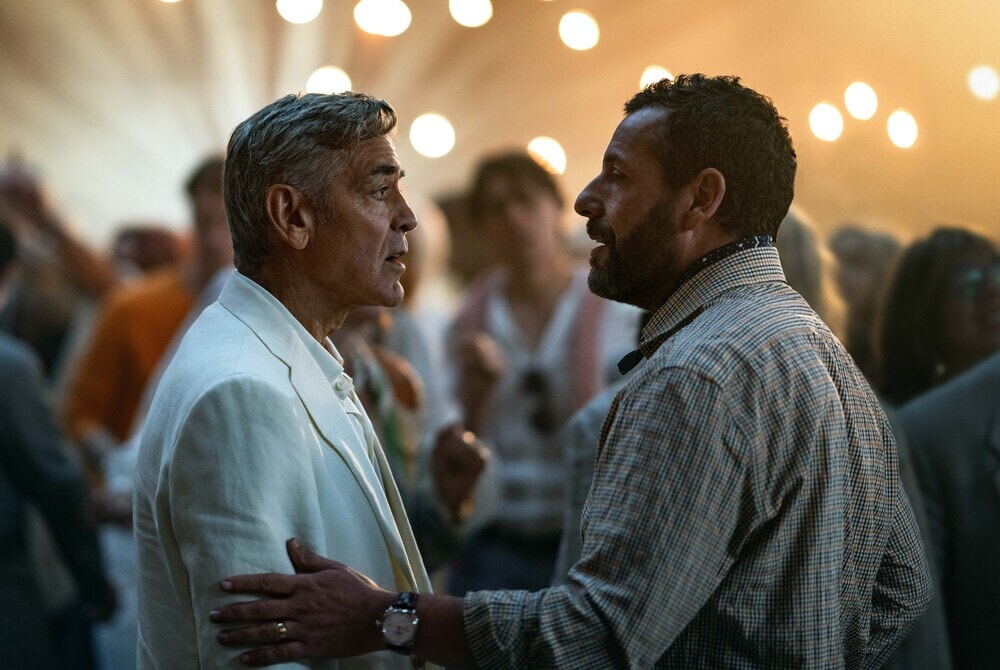
George Clooney and Adam Sandler star in JAY KELLY. (Photo: Netflix)
Regrets, he’s had a few, in the case of Jay Kelly, a drama that contemplates mortality and legacy through the eyes of a man forced to reconcile with his past.
Although it tends to confuse sentimentality with profundity, this labored showbiz satire from director Noah Baumbach (Marriage Story) is bolstered by a richly textured performance by George Clooney in the title role.
Jay is an effortlessly charming movie star in his 60s just wrapping his latest picture when he begins to endure a late midlife crisis after learning that his filmmaking mentor (Jim Broadbent) has died. Shortly afterward, he runs into a former classmate (Billy Crudup) he hasn’t seen in decades, which leads to dinner and an unexpected reckoning.
“All my memories are movies,” Jay laments while gradually realizing he’s spent a lifetime playing fictional characters and living in the pampered façade of celebrity while inadvertently neglecting his real-life relationships or engaging in meaningful self-reflection.
He’s estranged from his adult daughter (Riley Keough) and doesn’t have much contact with his aging father (Stacy Keach), either.
He experiences a humbling series of flashbacks to some pivotal memories both happy and heartbreaking. He sees that his characters are all better versions of himself. But by the time he accepts that and tries to make amends, is it too late?
Rather than preparing for his next shoot, Jay impulsively heading to Italy for a career retrospective, against the advice of his publicist (Laura Dern) and especially his beleaguered manager (Adam Sandler) — whose unrelenting devotion to Jay strains his relationship with his wife (Greta Gerwig) back home.
Clooney is dynamite in a role that seems tailor-made for him. He yields sympathy rather than pity for a man whose idyllic public life yields superficial pleasure while concealing a private volatility.
The remainder of the ensemble cast likewise is top-notch, led by Sandler’s nuanced turn as a yes-man seeking a fresh start of his own and Crudup’s riveting exchange.
The dialogue frequently crackles in the character-driven screenplay, although it struggles to balance whimsy with serious contemplation. Setting such a story in the movie world lacks broader relatability for its first-world problems, and it’s too stuffy to earn consistent emotional investment.
Taking the form of a confessional, Jay Kelly stumbles in trying to rehabilitate his image, both through our eyes and through his own.
Rated R, 132 minutes.